
I love cranberry sauce. It's one of my favorite parts of the Thanksgiving meal. I love the interplay of the intense tartness and sweetness, and the gorgeous jewel-like color stands out in the otherwise brown and white Thanksgiving plate.
For years, my contribution to the Thanksgiving meal has been pumpkin pie and whole-berry cranberry sauce. For both of these dishes, I usually go no further than the package for the recipe. This year, I decided to give
this recipe* from The Book a try. Next year, I'll go back to the recipe on the Ocean Spray package. (Sorry, they can't all be winners.)
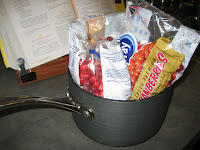
Before I go any further, I want to comment on an odd quirk that I've discovered as I cook my way through The Book. I don't know what kind of funky pots and pans they have in the
Gourmet test kitchens, but more than a couple of times, The Book calls for an impossibly small pot or pan in the preparation of some of its recipes. For example, in this recipe, The Book says to cook 12 cups of cranberries, 3 cups of sugar and 3 1/4 cups of water (18 1/4 cups of ingredients in all) in a 3 quart pan. Now, I know I was an English major, but I even I know that the laws of physics won't allow 18 1/4 cups of ingredients to fit into a 12 cup pot. The photo to the left shows the cranberries alone overflowing from my 3 1/2 quart pot. So, I used a stockpot to make this recipe, and the cranberries had plenty of elbow room.

I made the sauce by simmering the berries, water and sugar for about fifteen minutes until all of the berries burst. Then I strained the mixture through a cheesecloth-lined colander into a large glass bowl. After about fifteen minutes, I had a little bit more than three cups of beautiful, syrupy garnet colored cranberry juice, and a colander full of chunky cranberry solids. The Book says to discard this, but my wife (who I think lived through the Great Depression in a past life) wouldn't let me throw away all of that cranberry goodness. I took the solids, and the extra juice and mixed it all up an put it in the 'fridge, and I'm glad that I did. This made a delicious, chunky cranberry relish that was just a little bit thicker than the whole berry sauce that I usually make, and as I'll explain in a minute, it was better than the jellied cranberry sauce that is the object of this recipe.
To make the jellied sauce, mix together one cup of the cranberry juice, heated, with some plain gelatin that's been softened in some water. Once the gelatin is fully dissolved, the mixture is combined with the remaining two cups of juice and the whole thing is poured into a mold. I used a Christmas pudding mold that I have. I chilled it in the 'fridge overnight.
On Thanksgiving day, just before we ate, I ran hot water around the sides of the mold to loosen the jellied sauce. It took a little bit of patience, but eventually, the sauce slid out of the mold and onto the serving plate. The picture at the top of this post doesn't do the sauce justice. It was actually a much brighter, jewel-like red color, and it had a beautiful, glittering sheen. The taste, however, wasn't as great. The texture was a lot firmer than the canned stuff that we're all used to. It was a lot like cranberry Jell-O. The flavor wasn't as intense as I would have liked it either.
I was really more impressed with the chunky cranberry relish that I made from the by-products of the recipe that I was supposed to throw away. It's like that old saying, waste not, want not.
UPDATE: We had a lot of the whole berry cranberry sauce leftover, and so I made
this recipe from the Ocean Spray website for Quick Cranberry Nut Bread. It was great! Next year, I'm going to make extra cranberry sauce to be sure that I have enough leftover to make this quick bread again.
Date Cooked: November 26, 2008
Degree of Difficulty: Medium
Rating: Jellied Cranberry Sauce C; Whole Berry Sauce made from leftovers B+
* The recipe on epicurious is almost identical to the one in The Book, but it uses a bit more water and gelatin.
 Every year at Thanksgiving, I'm responsible for two things: pumpkin pie and cranberry sauce. If you've read my last post, you know that my attempt at mixing it up with the pumpkin pie was a bit of a bust. I wasn't taking any chances with the cranberry sauce, though. I decided to make this recipe as "something new," but I also made a batch of traditional whole-berry sauce using the recipe from the back of the Ocean Spray package.


