Showing posts with label Salads. Show all posts

Sunday, September 6, 2009

190. Roasted Beet Salad (p. 147)

A lot of people don't like beets. I can't understand why. They're sweet, earthy, and luxurious. They look, and taste, like red velvet. So, as soon as I got a bunch of beets in my CSA box, I didn't hesitate to make this recipe for Roasted Beet Salad.

First, I roasted the beets by wrapping them in foil and putting them in the oven for about an hour and a half. Then I let the beets cool, still in their wrapper, for about a half hour longer.

While the beets cooled, I cooked some sliced almonds in olive oil until they were lightly golden. I took the pan off the heat and let the almonds cool in the oil for a while. Then I took them out with a slotted spoon, put them in a small bowl and seasoned them with a little bit of salt. Usually, when I cook, I'm a clean-up-as-you-go kind of guy, but out of a momentary stroke of laziness, I left the oil in the pan on the stove rather than pouring it down the drain and rinsing the pan. It was a good thing that I didn't, because, even though The Book says nothing at this point in the recipe about reserving the oil, it turns out to be an important component in the salad dressing.

Anyway, while the oil sat in the pan, I whisked together some finely chopped shallot, lemon juce, red wine vinegar, sugar and salt. I added the almond-infused oil, and set the dressing aside.

Next, I peeled the beets. The Book says to "slip skins from beets." No way is it going to be that easy, I thought ... but it was. I turns out that as the roasted beets cool in their foil packet, the steam loosens the skins, and they really do just slip right off. Pretty cool! I sliced the beets, and added the slices to the dressing, tossing to coat. At that point, I did resume my neat-kitchen ways, and rinsed off the cutting board and wiped down the counter to prevent any permanent beet juice stains. Then, I cut a pear into matchsticks and prepared to plate the salad. I arranged the beets on top of a bed of greens (I used some baby spinach that I had in the fridge instead of the baby arugula or mache that The Book calls for). I topped the salad off with the pear matchsticks and the toasted almonds.

I enjoyed this salad. The beets were delicious, the dressing was light and had a really nice flavor. Cooking the almonds in the oil gave it a nice rich nuttiness, and the lemon and shallot were just the right light notes to round it out. The pears and almonds gave the salad a good crunch, and were a nice counterpoint to the soft, silky beets. The only thing I can think of that would have improved this salad would have been a nice bit of soft goat cheese on top.

August 8, 2009
Degree of Difficulty: Medium
Rating: A-

Tuesday, July 14, 2009

174. Dandelion Salad with Warm Pecan Vinaigrette (p. 137)

There's been a lot of talk lately about the benefits of locally-produced food. Heck, they just added the word "locavore" to the dictionary. And while the jury's still out on the environmental superiority of local food, I still prefer to buy local whenever I can. First, I like to support local small businesses. Next, there's something to be said for knowing the people who make your food and where it comes from. Finally, local food is fresh and in season, it has to be, and that means that it tastes better, which really makes all the difference.

Some people have taken the "eat local" movement to the extreme, like Barbara Kingsolver, whose Animal, Vegetable, Miracle chronicles her family's year of eating only food they produced themselves or obtained from local producers. I loved the book, but I can't bring myself to follow in her footsteps all the way. (I'm sorry, but I just can't give up bananas and oranges. Import the stuff that's worth importing, I say.) And I don't have the space, sun, or time to grow my own vegetables. But, I still do what I can to eat more locally-produced food. I patronize my local food producers, Mann Orchards and Raymond's Turkey Farm. I visit the Manchester Farmers' Market near my office. And this year, I'm participating in a CSA.

If you haven't heard, CSA or "community supported agriculture" is an agricultural business model in which people purchase "shares" of a local farm's seasonal production. Each week during the growing season, the CSA members get a box full of whatever's growing on the farm. The CSA members share in the risks and rewards of the farm. The amount and variety of the produce in the week's box will depend on factors like weather and pests. CSAs have grown in popularity in the last couple of years, and in my area, there are many to choose from. Local Harvest is a good source for information on finding CSAs near you.

My CSA share is arleady paying dividends for The Project. Some of the ingredients called for in The Book are hard to find in the grocery store. In the first two weeks of the growing season, my CSA share has given me two such ingredients: purslane (watch for the post coming soon), and the dandelion greens I needed for this recipe.*

First, I washed the dandelion greens, trimmed off any thick stalks and chopped them into large, bite-sized pieces and put them in a bowl. Then I cooked some chopped garlic and chopped pecans in some olive oil, stirring until the garlic was golden. I stirred in some balsamic vinegar, salt and pepper, and drizzled the hot dressing over the greens.

This was a delicious salad. The greens were crisp and fresh with a nice peppery bite, but not at all bitter. The dressing was excellent. The nuts and balsamic vinegar gave the dressing a nice sweetness and depth. The garlic was just right, fragrant but not overpowering. I also liked the interplay between the cold greens and the warm dressing.

Date Cooked: July 3, 2009
Degree of Difficulty: Easy
Rating: A-

*The recipe on epicurious.com is very similar to the one in The Book, but it uses hazelnuts instead of pecans.

Wednesday, July 1, 2009

168. Summer Fruit Salad with Mint Sugar (p. 167)

I made this recipe to bring to a cookout with my wife's "moms group." It's just a simple fruit salad of cherries (pitted and sliced), peaches (pitted and sliced) and green grapes (seedless and sliced). But being a Gourmet recipe, it has a special touch that takes it from ordinary to extraordinary. That special touch is the mint sugar.

I took about a quarter-cup of packed whole fresh mint leaves and three tablespoons of granulated sugar and whizzed it up in the food processor. The mint leaves got finely chopped and fully incorporated with the sugar. When I opened the food processor, I was pleasantly surprised by the intense, sweet mint aroma. All of the mint's essence was released by the processing with the sugar. It had the smell of those LifeSavers Wint-O-Green mints, but it was a fresher, and even more intense scent. Awesome!

Right before we left for the cookout, I sprinkled the mint sugar over the fruit and gently stirred it to coat all of the fruit. As the fruit sat, the sugar combined with the fruit's juices to make a light, sweet and minty syrup. This was a delicious and simple fruit salad, and just the thing if you're looking for something a little different. The only drawback is that at first glance, the fruit salad looks like it's been sprinkled with dried oregano.


Date Cooked: June 14, 2009
Degree of Difficulty: Easy
Rating: A

Tuesday, June 30, 2009

167. Old-Fashioned Potato Salad (p. 148)

My sister-in-law makes the best potato salad in the world. I'm serious. It's death-row-last-meal good. The potatoes are tender but not mushy. The vegetables (carrots, celery, green peppers, and onion) are crisp and sweet. The layer of sliced hard-boiled eggs on top is sunny and bright. And, most important, the mayonnaise ratio is exactly right. No family cookout is complete without her perfect potato salad.

I had great expectations for this recipe. Maybe I set my hopes too high, because it just didn't measure up to my sister-in-law's potato salad.

First, I peeled a couple of pounds of Yukon gold potatoes and cut them into one-inch pieces. I boiled them for a while until they were tender but not too soft. I'll admit that I cut a corner here. The Book says to cook the potatoes "in their jackets," and peel and cut them after they've cooled a bit. I usually try to follow The Book's instructions exactly, even if I think that they're fussy or a waste of time. But the day I made this recipe, I was a bit overwhelmed. I attempted to make six recipes from The Book for the same meal, and as lunchtime came and went with food still not on the table, I had to compromise. The Book says that its cooking method results in a better texture. But in my opinion, the texture of the potatoes was not the problem with this salad.

After the potatoes were cooked, I tossed them with some cider vinegar and salt. Next I added some chopped celery, white onion and a cup of mayonnaise. I topped it off with some sliced hard boiled eggs.

This potato salad could have been good. The potatoes, even though I didn't cook them the way The Book wanted me to, were good. The eggs gave it a nice richness. The celery gave it a nice crunch. The white onions (which are a lot milder than yellow or red onions) gave it a nice sweetness and bite. But, there was way too much mayonnaise in this salad. It was swimming in the stuff. The next time I make this salad, I'm going to use about half as much mayonnaise, and I'm going to add more vegetables, like carrots and green peppers.

Date Cooked: June 13, 2009
Degree of Difficulty: Easy
Rating: B-

Thursday, June 25, 2009

164. Green Bean Salad with Pumpkin Seed Dressing (p. 143)

When my sister was little, she hated green beans. She'd do anything she could to avoid eating them. I don't know if she's changed her view on green beans now that she's an adult. If not, this recipe might just bring her around.

What makes this salad so special is the dressing. The Book calls it "Mexican Pesto." The key ingredient in the dressing is green pumpkin seeds. First, I toasted the seeds in a dry skillet for a few minutes. I set aside a handful of the seeds for a garnish, and whizzed up the rest with some extra-virgin olive oil, water, fresh lemon juice, garlic, ground cumin, and fresh cilantro. The result is a surprisingly smooth, creamy and delicious dressing.

Next, I cooked some fresh green beans in some salted, boiling water for a few minutes until just tender (don't let them get mushy!). The Book says to drain the beans and plunge them into ice water to stop the cooking. I drained them and ran them under cold water instead and I think that it worked just as well. I let the beans drain completely and I dabbed them with some paper towels to get rid of any extra moisture.

I tossed the beans with some of the dressing, spread them out in a dish, arranged some tomato wedges on top, and drizzled on the remaining dressing and sprinkled some chopped cilantro and the reserved pumpkin seeds on top.

I really liked this salad. First, it was a really attractive dish. The bright green and red colors are very appealing. Next, the flavor was excellent. The beans were crisp and fresh tasting. The dressing was creamy and delicious. The combination of the garlic, lemon and cumin is really nice, and the pumpkin seeds are a very mild component ... very similar to the pine nuts that, according to The Book, are an acceptable substitute.


Date Cooked: June 13, 2009
Degree of Difficulty: Medium
Rating: A-

Saturday, May 23, 2009

150. Potato and Thyme Salad (p. 148)

I made this potato salad as part of the lunch buffet for my son's dedication ceremony celebration on Mother's day. I was looking for an easy, make-ahead side dish that would go with the marinated turkey breast that I was making, and that would work with my wife's current dietary restrictions (no dairy, soy or wheat). This fit the bill.

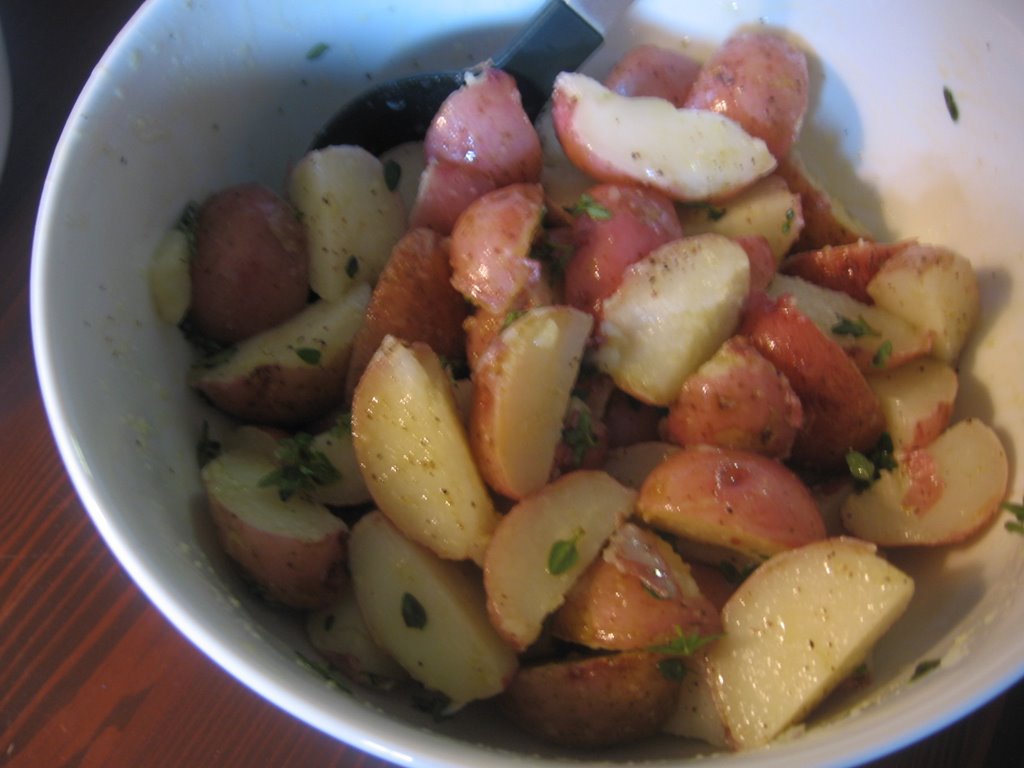
The Book says that this is "no suburban backyard potato salad." Instead, this recipe,* which comes from the Ballymaloe Cooking School in Ireland, is simple, understated and totally unfussy. It's so simple that there are only three ingredients: small red boiling potatoes, fresh thyme leaves, and olive oil (plus salt and pepper to taste).

First, I washed and dried some fresh thyme. I plucked the leaves and buds off the woody sprigs. This what kind of tedious, but not too hard since you can sort of zip the leaves off the sprigs by running your fingers against the direction that the leaves grow. Once I had gathered a respectable amount of leaves, I put them in a little bowl and set them aside.

Next, onto the potatoes. I washed them well and put them (whole) into a pot of salted water. The Book says to cook the potatoes for 15 to 20 minutes until "just tender." I've had my fair share of undercooked potatoes (they're pretty much inedible) so, I made sure that they were good and tender. In retrospect, I wish that I had taken them off the heat just a little bit sooner, since what you're looking for here are potatoes that are cooked, but still just the slightest bit on the firm side.

After the potatoes had cooled just a bit, I cut them into quarters, sprinkled them with the thyme leaves, drizzled on the oil and tossed to coat. I seasoned it with some salt and pepper, and that was it.

My wife didn't like this dish at all. She called it "the worst potato salad I've ever had," and demanded that I give it a "C" rating. (Geez, tell me how you really feel.) I didn't have quite as negative reaction to this recipe. I just thought that it was kind of "meh." I suppose that "understated" and "boring" are two ways to look at the same thing.

(Oh, by the way, in all of the hustle and bustle of getting ready for the lunch, I forgot to take a picture of this dish. The photo at the top of this post comes from Teena's blog. I hope she doesn't mind me borrowing her picure ... because I'm going to do it again with my next post, too.)

Date Cooked: May 9, 2009
Degree of Difficulty: Very easy
Rating: B-

* This recipe is not on epicurious.com.

Tuesday, May 5, 2009

144. Taco Salad with Salsa Vinaigrette (p. 164)

Let's be honest here. Taco salad is something you'd expect to find in an Applebee's menu, not in The Gourmet Cookbook. But there it is in The Book, and so, I made this recipe.*

This being Gourmet, however, The Book calls for you to make your own tortilla chips (although the headnotes say, with a bit of a judgmental sigh, that store-bought chips are "perfectly fine"). Really, though, the chips couldn't be easier. Just heat some vegetable oil (I used canola) until it's good and hot. While the oil is heating, cut up some corn tortillas into wedges with your kitchen shears. Then pop a handful of the wedges into the hot oil for a few seconds until they crisp up and start to change color (they go from golden to brown very quickly, so resist the temptation to wait just one more second). Drain the chips on some paper towels and sprinkle them with a little bit of salt. There's nothing better than fresh, warm tortilla chips. These could be a recipe on their own in The Book, and I could see myself making these again some day.

Other than the crisp tortillas, the other thing that makes a taco salad a taco salad is the seasoned taco meat. The Book calls for ground chuck, but because my wife "don't eat no meat" I used ground turkey. First, I heated a little bit of oil in a pan and added some chopped onion, garlic, cumin and chili powder and cooked until the onions were soft. Then I added the turkey and some tomato paste and cooked until the turkey was done.

While the meat cooled a little bit, I made the salsa vinaigrette. I blended together some garlic, vinegar, lemon juice, cumin, salt and pepper. With the motor running, I poured some olive oil through the top opening of the blender until it was nice and emulsified. Then I added some chopped tomatoes, chopped jalapeno and cilantro and whizzed it up some more. The result was a creamy-looking, celadon colored dressing.

To plate the salad, I laid out some romaine lettuce on a couple of plates, topped it with a mound of the taco meat, some fresh tomato wedges and a handful of the homemade tortilla chips. I also added some shredded cheddar cheese to mine (my wife is stil dairy/soy/gluten free), and drizzled the vinaigrette on top of the salad.

I liked this salad. The meat was good, but the dressing was the real star. Bright and pungent with the cumin and jalapeno, with a nice creamy texture. My wife said that the salad was good but, "basic." For crying out loud, I made homemade tortilla chips, and she called it "basic"?!? What she meant, was that the lettuce and tomato combo was "basic," and she would have liked to have seen some avacado and diced red and green peppers. Oh, yeah. That would have been a nice touch.

Date Cooked: April 25, 2009
Degree of Difficulty: Easy
Rating: A-

*This recipe is not on epicurious.com.

Monday, April 27, 2009

140. Sushi-Roll Rice Salad (p. 151)

The Book calls this recipe a "deconstructed sushi roll." It could also be called a "California Roll in a Bowl."

First, the rice. After all, "sushi" means vinegar rice. I rinsed some sushi rice (medium-grain Japanese rice) in a few changes of water, and then I put it in a sieve to drain. Then, I combined it with some water in a pot, brought it to a boil, cooked it for a few minutes, and then took it off the heat to stand, covered, for a while longer. The short cooking time, plus the longer steaming time off the heat results in a tender, chewy sushi rice with just the right amount of stickiness. While the rice was sitting, I brought some rice vinegar, sugar and salt to boil in a small saucepan just long enough to dissolve all of the sugar. Then I spread the rice into a shallow baking dish and sprinkled the vinegar mixture over it and tossed it with a little wooden paddle that someone gave us in a "sushi kit." The step of spreading the rice in a baking dish and gently sprinkling it with the vinegar might seem like unnecessary overkill, but I remember seeing something on TV once about how sushi is made, and the cooling and seasoning of the rice is apparently a very important part of its taste and texture. I think that it would be a mistake to just dump the vinegar into the pot of rice and start stirring away.

Next, the vegetables. First, using a vegetable peeler, I made some very thin carrot slices, which I then cut into diagonal strips (sounds like a pain, but it only took a couple of minutes). Next, I chopped some scallions and seedless cucumber. (The Book's instruction to "seed" the "seedless" cucumber struck me as a bit odd, but maybe that's just me.)

To make the dressing, I whisked together some wasabi paste, water and canola oil in a large bowl. (As I've noted a couple of times, I'm cooking dairy/soy/gluten free these days. I made my own wasabi paste using wasabi powder and water because the prepared wasabi paste contained "lactose." Also, The Book calls for "vegetable oil," but if you read the lables, every brand of "vegetable oil" is 100% "soybean oil." So, I used canola instead.) Then I added the rice, carrots, cucumber, scallion and some chopped pickled ginger and toasted sesame seeds. I tossed it all together and topped it off with sliced avacado, and a sprinking of nori "confetti" that I cut with kitchen shears from a sheet of toasted nori.

The Book suggests using fresh shiso leaves to plate the salad. That would make a dramatic presentation, but this was just a casual Sunday night dinner at home, and it probably would have required a trip to the Super 88 Market in Boston's Chinatown (the only place I know of to get Aisan produce). So, I skipped them.

This dish was a nice surprise. It was delicious and pretty, too. We really liked the taste of the rice with the nice crunch of the cucumbers and carrots. The rich and creamy avacado (perfectly ripe!) was the perfect contrast to the crispness. The rice was tender with the right mix of sweet and sour (sugar/vinegar balance). It really tasted like an unrolled California roll. The only thing missing was the imitation crab meat, but that's my least favorite part of California rolls anyway.

Date Cooked: April 19, 2009
Degree of Difficulty: Medium
Rating: A-

Monday, March 30, 2009

128. Crunchy Vegetable and Brown Rice Salad (p. 150)

I've never thought that there was anything strange about pasta salad. So why would I even think for a second that there's anything odd about rice salad. Rice salad? You've never heard of it either? Well, now that I've made this recipe, my eyes have been opened to a whole new world of salad possibilities.

The first thing I did to make this salad was to make the rice. The Book calls for short grain brown rice. I've never used this kind of rice before. These short, chubby grains of brown rice are about the size and shape of the Arborio rice that you'd use for risotto, but they're a lot less starchy. You cook it more like pasta than rice, boiling it in lots of salted water and draining it in a colander and rinsing it with cold water when it's done cooking.

While the rice was cooking, I chopped up some carrots, celery, and bell peppers into quarter-inch dice. This recipe is definitely good practice for your knife skills. The Book calls for red bell peppers, but I used red, yellow and orange to give the salad more color. I blanched these vegetables in boiling water for one minute, drained them in a colander and then plunged the colander into a large bowl of ice water to stop the cooking.

Next, I made the dressing. I whisked together some lemon juice, chicken broth, country-style whole grain mustard, olive oil, and some salt and pepper. I tossed the dressing with some baby arugula, the blanched vegetables, some chopped scallions, and the cool rice.

This salad was beautiful and delicious. It looked like a party on a plate ... like brightly colored confetti. The textures were excellent. The crunchy vegetables, crisp arugula and tender rice all combined together very well. The dressing was light, bright and uncomplicated. The Book says that this salad can be eaten as a main course. I served this salad with my Seared Salmon with Balsamic Glaze, and it was a nice match. I think that this salad would be a welcome addition to a summer picnic, too.

Date Cooked: March 21, 2009
Degree of Difficulty: Medium
Rating: B+

Sunday, January 18, 2009

93. Parmesan Balsmic Vinaigrette (p. 172)

I wanted to make a dinner out of the Potato Latkes I made a few weeks ago. So, I threw together a salad and made this recipe* for dressing to go with it.

This is a great basic, go-to vinaigrette that I'm glad to have in my arsenal. It uses mostly pantry items and things that I usually have on hand anyway, so I can make it anytime I want a salad and don't have any dressing.

I started by mashing together some garlic and salt with the side of a heavy chef's knife. (I probably could have done this with my mortar and pestal, too.) Then I whisked together the garlic-salt paste with some balsamic vinegar, lemon juice, grated Parmigiano-Reggiano, salt, pepper and a some minced fresh basil. Finally, I whisked in some olive oil in a slow stream until it was well blended.

I put the dressing on a salad of Romaine, grape tomatoes, cucumbers and some baked, breaded chicken. Yes, they are Short Cuts. Don't judge me. They're quick and they're good.

Date Cooked: December 20, 2008
Degree of Difficulty: Easy
Rating: A-

* This recipe is not on epicurious.com.

Tuesday, August 12, 2008

38. Watermelon, Tomato, and Feta Salad (p. 145)

What's with Gourmet's obsession for putting watermelon in places it doesn't belong? Before starting The Project, the most exotic thing I'd ever done with a watermelon was to make watermelon sorbet from Alice Waters's cookbook. That, and playing the greased watermelon game at Boy Scout camp when I was a kid ... but that's another story. So far this summer, however, I've already made Watermelon Gazpacho and Watermelon Rind Chutney. Now, I've made this strange recipe for a savory salad featuring watermelon. And I'll be darned if it wasn't half bad.

The recipe is simple enough: just combine diced watermelon, diced tomatoes, crumbled feta and chopped cilantro, along with some oil, vinegar, salt and pepper. I cut the recipe in half since it's just me and my wife, and after the Watermelon Gazpacho incident, I didn't have high hopes for leftovers. Turns out, I was wrong, and the salad held up pretty well in the refrigerator for a day or two, and I enjoyed some with my lunch today.

The recipe calls for white Balsamic vinegar. I've never heard of such a thing before. According to this site, white balsamic vinegar is:
A version of Balsamic vinegar that is made with white wine vinegar and grape must (fresh pressed juice with seeds and skins). Traditional balsamic vinegar is made with red wine vinegar, thus providing a deep reddish color which may add a undesirable tint to the food being dressed. The white variety is often used when the color of white sauces or foods will be adversely affected by the dark brown color of traditional balsamic vinegar. White balsamic vinegar is milder and less sweet than regular Balsamic vinegar and is often considered more suitable for use with salad dressings, since it does not have a strong flavor that can be overpowering when used on salad greens.

I was impressed that my local mega-mart not only carried it, but even had it as a product in its in-house line of "fancy food." Way to go mega-mart! I tasted some of the vinegar on its own before I put it into the salad, and it certainly is milder and thinner than regular balsamic. I thought that it was actually a little sweeter than regular balsamic, and reminded me of cider vinegar. (Hey, wait a minute. Did the mega-mart pull a fast one on me? If so, shame on you mega-mart!)

As was the case with the Watermelon Gazpacho and the Watermelon Rind Chutney, it was hard to find a perceptible watermelon flavor in the finished salad. I sensed a glimmer of watermelon every couple of bites, but for the most part, I couldn't tell whether I was eating watermelon or tomato, or both. What I did sense was refreshment and a nice melding of cool flavors and different textures. The feta gave the salad a nice saltiness and tang, but if I had it to do over again, I'd add more feta. Not surprising, since I always want to add more feta to any recipe that calls for feta. What can I say, I like the stuff.

My wife put it well when she said that this salad was very good, but it wasn't a "revelation." She also accused me of "grade inflation" with my ratings, and suggested that I should reserve "A" ratings for dishes that are revelations. So, it's for that reason that this recipe gets a B.

Date Cooked: August 10, 2008
Degree of Difficulty: Easy
Rating: B

Thursday, July 24, 2008

28. Lime Molasses Vinaigrette (p. 171)


I decided to make a salad to go with my Watermelon Gazpacho, because, as I was reminded by my Mango-Spacho experience, by itself, "Soup is not a meal, Jerry."

I came across this vinaigrette in the salads section of The Book, and it looked light and interesting. The combo of molasses and lime isn't something that I'd ever seen before, and I was intrigued.

The vinaigrette comes together very easily. You just whisk together some molasses, lime juice and Tobasco in a bowl. Then you quickly cook some chopped scallions in some oil and then whisk that into the other ingredients. The vinaigrette is meant to be served warm or at room temperature.

I poured the dressing over sliced grilled chicken on a bed of mixed greens (bagged, don't judge), cucumbers and grape tomatoes. I really liked this dressing. Each of the components remained pretty distinct, so you got the sweet smokiness of the molasses, cut with the acidity of the lime and the heat from the Tobasco. Overall, it was a nice change from the usual vinaigrette.

Date Cooked: July 20, 2008
Degree of Difficulty: Easy
Rating: B+

Monday, July 7, 2008

16. Creamy Slaw (p. 140)

My family decided to have an old-fashioned backyard cookout for the Fourth of July: hot dogs and hamburgers on the grill. And nothing goes better with hot dogs and hamburgers than a great coleslaw.

This recipe is the classic backyard cookout coleslaw. When you think of coleslaw, this is what you think about. Cookbooks and food magazines today are always trying to get us to try "a new twist" on classic dishes or to give us "something a little different." Sometimes, you just want the real thing, and that's what you get with this coleslaw.

The Book calls this recipe "straightforward," and that's exactly what it is. It's nice and easy to make, especially when you do all of the prep work in the food processor like I did. I whizzed the onion and green pepper to get them finely chopped, then I slapped on the shredding attachment for the carrot, and then the slicer attachment for the cabbage. The dressing came together easily too: it's just mayo, sour cream, and a little vinegar, salt and pepper. That's it. At first I was a little concerned that there wasn't going to be enough dressing, but as I tossed the slaw, it all got a nice even coating. Also, I made this slaw the day before the cookout, and as it rested overnight, some of the liquid was drawn out of the vegetables, making even more dressing.

Date Cooked: July 3, 2008
Degree of Difficulty: Easy
Rating: A

Thursday, July 3, 2008

14. Asian Cucumber Ribbon Salad (p. 142)

The idea of this salad is long, lightly-dressed strands of paper-thin juicy cucumber slices. Sounds great, and it might have worked out better if I had a proper mandoline.

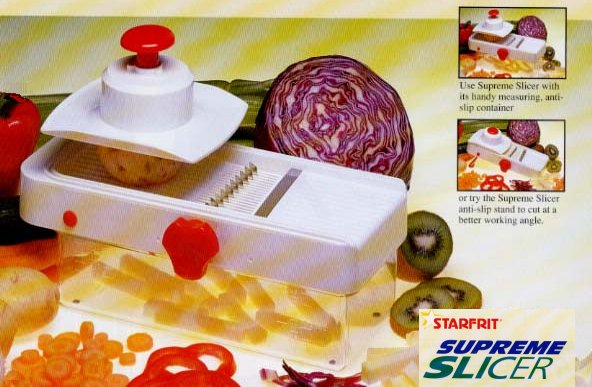
Instead, I have the "As Seen on TV" Super Slicer that my mother-in-law bought in a moment of infomercial - watching weakness.

The Super Slicer is actually a surprisingly useful gadget. I used it to slice potatoes for the Gratin Dauphinois in MtAoFC with great success. But, despite the claims of the infomercial hosts, "paper-thin" slices is something that the Super Slicer just doesn't do.

As a result, my cucumber slices were more like 1/4 inch than the 1/8 inch called for in The Book, they were much more rigid than the effect I think I was aiming for. So, I sliced them lengthwise and made something more properly referred to a cucumber "noodles" than "ribbons."

This recipe is the epitome of "cool as a cucumber." It's as light and refreshing as can be. The half-teaspoon of sesame oil in the dressing is just the right amount to give the salad a nice toastyness and silky feel without having a too intense sesame flavor. I'll make this recipe again once I get the right equipment, but I think that I'll skip the unnecessarily fussy step of heating the vinegar and sugar.

One last note, The Book says not to let the dressed salad sit for more than 20 minutes or else it will get soggy. However, we had some salad leftover, and we put it in the fridge. I ate it as a snack a couple days later, and it was still crisp and delicious.

Date Cooked: June 29, 2008
Degree of Difficulty: Easy
Rating: B

Thursday, June 26, 2008

10. Basic French Vinaigrette (p. 168)

There's not too much to say about this one, it's salad dressing after all.

I wanted to serve something with the Eggplant Pizza, and I figured that a salad would be just the thing. Not wanting to miss an opportunity to check off a recipe for The Project (after all, I've still got more than a thousand to go) I went to The Book to check out what it had for dressings.

This recipe is exactly what it says it is: Basic French Vinaigrette. Vinaigrette is one of those things that most cooks seem to just "know" how to make, and everyone's formula is a little bit different. The Book's acid to oil ratio is 2 tablespoons to 1/3 cup. My wife makes a similar vinaigrette all the time, but her formula is heavier on the vinegar and lighter on the oil.

The Book gives the option of using either white wine vinegar or lemon juice as the acid. I chose lemon, which gave it a nice kick. The Dijon mustard is also a key element.

All in all, this is a good basic recipe to have in the arsenal. The vinaigrette isn't very photogenic on its own (see photo to the left), so the photo above is of the salad dressed with the vinaigrette.

Date Cooked: June 22, 2008
Degree of Difficulty: Very Easy
Rating: B